Saturday, July 29, 2023

THE DIFFERENT TYPES OF NARRATIVES

 There are different types of narratives; this blog talks about six types: myth, legend, epic, folktale, fable and short story. This blog also aims to show the distinction among them.


Let us use one story line to transform into the different types of narratives to clearly show the distinction. The creation story below is based from an Igorot story of Creation while the rest are already products of jcogtas's imagination.


This type of narrative revolves around the actions of gods and goddesses and their interactions with mortals which usually result to supernatural events. A myth is often depicted as a story of the ancient world which was usually believed to be true.

CHARACTERISTICS OF A MYTH NARRATIVE:
  • mysterious
  • explains the existence of the universe and its dwellers
  • consists of non-human characters
  • set to a previous proto-world: A proto-world describes this one we have now but a different one.
  • interplay between worlds
  • bends or breaks natural laws

EXAMPLE

Lumawig, the great spirit, made humans out of reeds and distributed them in different parts of the world. He taught them how to live in order to survive.

_____________________________________________________________________________


A legend is about a story of a character who because of his or her experiences and the circumstances around him or her resulted to an important phenomenon. Therefore, it is a story of human actions.


CHARACTERISTICS OF A LEGEND NARRATIVE:
  • has a bit of historical truth which include a human hero
  • includes beliefs and ideas of culture and even miracles believed to have happened

EXAMPLE

Yamot prayed that Lumawig, the great spirit, would bless him and his wife Tiyang with healthy children. He offered the great spirit his harvest and his best poultry. When it is time for Tiyang to give birth, Yamot was saddened because that day he lost Tiyang and their child. He faced the great spirit Lumawig in anger and mocked him; In return, the great spirit punished Yamot. Lumawig turned Yamot into a very hot body of water no one would want to swim into. Years passed and Yamot had been avoided by people until a very exhausted farmer came to bathe in it. Yamot was outraged so he made the waters really hot and so the farmer took off. The next day the farmer came and brought some eggs then put them into the hot water of Yamot. The eggs were cooked. From then on people flock to Yamot and called him the Yamot spring.

______________________________________________


Folktales are usually about ordinary people and everyday life who may encounter monsters, magical beings, and even trickery.


CHARACTERISTICS OF A FOLKTALE NARRATIVE:
  • exaggerated
  • orally passed on to generations
  • unwise and one-sided characters
  • questions are answered before the story ennds
  • shorter and simpler plot
  • lifts heroes and heroines to higher and more refined levels like being so beautiful and the like

EXAMPLE

Three miles from the Yamot spring was a huge mountain. On your way up you would be greeted by the sounds of bats who dwell in a cave somewhere. Most passersby simply ignored the sound and went on with their journey because it was believed that if you stopped to listen to the bats, you would be led astray and will never find your way home. One day, Batugan, a goatherd,  went to find his goat but he was led to the noisy bats so he followed the sound. He went on walking and walking until he found himself in a dark cave where the bats  live. He was outraged that he couldn't find his goat there. In his anger, he torched the bats who live there. The goddess of the mountain punished him and so he shall endure an endless journey to gather bats once more to replace the ones he killed.

______________________________________________


An epic tells of a story of the past, of a distant time, of mythological characteristic. An epic was originally and generally  told orally.

CHARACTERISTICS OF AN EPIC NARRATIVE:
  • plot revolves around a hero with unbelievable stature like almost divine;
  • character possesses super human strengths
  • setting is vast as it may include the adventures of the characters
  • narrator is omniscient; a tell-all
  • represents moral ideas

EXAMPLE

Batugan spent most of his lifetime gathering the bats he needed to replace the one's he killed. In his travels he conquered beasts, fell in love, found a family and became a great leader of a prominent tribe. Because he was true to his promise to the goddess of the mountains, he was granted the strength of ten men to help him defend his tribe. With such strength his fame spread all throughout the lands beyond his tribe. Men of high stature came to him and asked for his help against monsters who attacked villages. Batugan never hesitated to help until he became old. When the day of his passing came, the universe bled. His son Mandaragat who was then of a very young age inherited his strength but no father shall be there to train him.


___________________________________________________________________________


The purpose of writing fables is to convey a moral lesson. Fables also give readers a chance to laugh at the follies of of the characters which actually represent that of a human being's. They are very helpful in teaching children good lessons based on examples. 

CHARACTERISTICS OF A FABLE NARRATIVE:
  • use talking animals as main characters
  • personifies actual human characteristics
  • short and usually consists only of two to three characters 

EXAMPLE

Batugan's goat, Malaya, went to walk miles away from her master. Malaya was then captured by the bats of the mountain three miles from the Yamot spring when she got inside the cave. Sumpok, the leader of the bats, fell in love with her. Malaya only laughed at him as they are of different species. Their union would be an abomination. However, Sumpok showed dedication and eventually Malaya accepted his love as he had proven worthy. The goddess of the mountain made Malaya into a bat so that she could be with Sumpok.


______________________________________________


A short story is a narrative of interrelated events concerning the conflict and resolution.

CHARACTERISTICS OF A FABLE NARRATIVE:
  • mostly revolves around single incident, character or period of time
  • readable at one sitting
  • mostly shows a decisive moment
  • there is often little action

EXAMPLE

In a high-rise condominium lived a prominent family who are of political descent. Tony, a successful businessman, and a loving father ends the day by tucking in his daughters Loren and Mia by telling them stories about Mandaragat, the great conqueror. The story of the great conqueror was written by his late wife, Tanya, who died of cancer.

________________________________________________


Originally published at jeanillec.blogspot.com 
in 2020.


References:

Ashlimann, D.L. (2003). Creation Myths from the Philippines.

Legend. (2015) Retrieved from https://literarydevices.net/legend/

Jagadisan, S.  (2010). Characteristics of a Short Story. Retrieved from 

Drake, T. Six Elements of the Epic. Retrieved from 


SUBJECT - VERB AGREEMENT


The agreement between a subject and a verb is essential in grammar. Let us clarify first what a subject is and what a verb looks like.

The subject of a sentence is that thing or person being talked about performing the action to complete the sentence. The subject can either be a noun or  a pronoun.

The verb on the other hand is the word that expresses the action done by the subject (action verbs). If not action, it could simply just links the subject to the rest of the sentence with the intention of presenting solely a state of being (be verbs). Other verbs also function as aids to the main verb.  thus are called the helping verbs.

Here goes the basic rules:

Plural subjects could mean nouns or pronouns. Here are the list of nouns to help you identify whether they are singular or plural especially when used as subjects 

Add –s to pluralize most nouns.


          computer - computers


solution – solutions

          solo - solos

alto – altos

          chief - chiefs

proof - proofs


Add –es to pluralize nouns ending in x, s, z, sh, ch and some words ending in o.


          box - boxes


echo - echoes

          class - classes

hero - heroes

          church - churches

potato - potatoes


Some words ending in o can either be added with –s or –es to form their plural.


cargo – cargos / cargoes


motto – mottos / mottoes

 halo – halos / haloes

tornado – tornados / tornadoes

mango – mangos / mangoes

tuxedo – tuxedos / tuxedoes

volcano – volcanos / volcanoes

flamingo – flamingos / flamingos

banjo – banjos / banjos

memento – mementos / mementoes


Nouns ending in y preceded by consonants form their plural by changing to i, then adding     –es.


          candy - candies


dairy - dairies

          fairy - fairies

lady - ladies

          nanny - nannies

baby - babies


Nouns ending f or fe form their plural by changing f or fe to v, then adding –es.


          scarf -scarves


half -halves

          knife - knives

life - lives

          wife - wives

leaf - leaves


Nouns ending f or fe form their plural by changing f or fe to v, then adding –es.


          scarf -scarves


half -halves

          knife - knives

life - lives

          wife - wives

leaf - leaves


Some nouns ending in f or fe form their plural by adding either –s or -es


       wharf – wharfs / wharves


calf – calfs / calves

      dwarf – dwarfs / dwarves

hoaf – hoafs / hoaves


Irregular nouns change in spelling when pluralized.


          man - men


mouse - mice

          louse - lice

goose – geese

child – children

ox - oxen


Some nouns have the same singular and plural forms.


sheep - sheep


headquarters - headquarters

moose - moose

species - species

salmon - salmon

swine – swine

shrimp - shrimp

barracks - barracks


Some nouns are indivisible pairs and thus always have a plural form.


jeans


forceps

shorts

goggles

pajamas

scissors

shears

tights


Some nouns are always plural in form and in meaning.


clothes


savings

groceries

belongings

remains

goods


Some nouns may be plural in form and are singular in meaning.


news


cards

politics

physics

mumps

Phonetics

Billiards

mathematics


There are nouns that could either be singular or plural depending on use.


statistics


politics

acoustics

gymnastics

economics

ethics

athletics

phonetics


Nouns with Greek and Latin origins retain their foreign plural form.


fungus - fungi


medium - media

curriculum - curricula

forum - fora

stimulus - stimuli

syllabus - syllabi

thesis - theses

alumna - alumnae


Some nouns with Greek and Latin origins can either be pluralized by adding –s or –es or just by retaining their foreign plural forms.


radius – radii / radiuses


formula – formulae / formulas

matrix – matrixes / matrices

apex – apexes / apices


To decide whether a verb or verb phrase agrees with its subject:

1. Find the verb of verb phrase. 
     Martina speaks so fast.
     VERB: speaks
2. Ask Who? or What? before the verb to find the 
    subject.
     WHO SPEAKS?   Martina
3. Use a singular verb with a singular and a plural verb with a plural subject.

IMPORTANT: The verb needs to agree with only the subject, not with any other word in the sentence.

TRY THIS!

1. People (are, is) using video-sharing websites to 
    post their own videos.
2. Even my grams (enjoy, enjoys) online videos.

prepositional phrase is a phrase introduced by a preposition. Examples of prepositions are of, in, around, with, to, at, under and many others.

Check out the details of the example above: 
The wings of a monarch butterfly are orange and black.

SUBJECT :                  wings
PREPOSITIONAL PHRASE:    of a monarch butterfly
VERB:                      are

The verb "are" is plural because the subject, "wings" is plural. The noun butterfly which is part of the prepositional phrase does not affect the verb.
TRY THIS!

3. A butterfly in the early stages (are, is) called a  
    caterpillar.
4. Insect lovers around the world (collect, collects) 
    moths and butterflies.
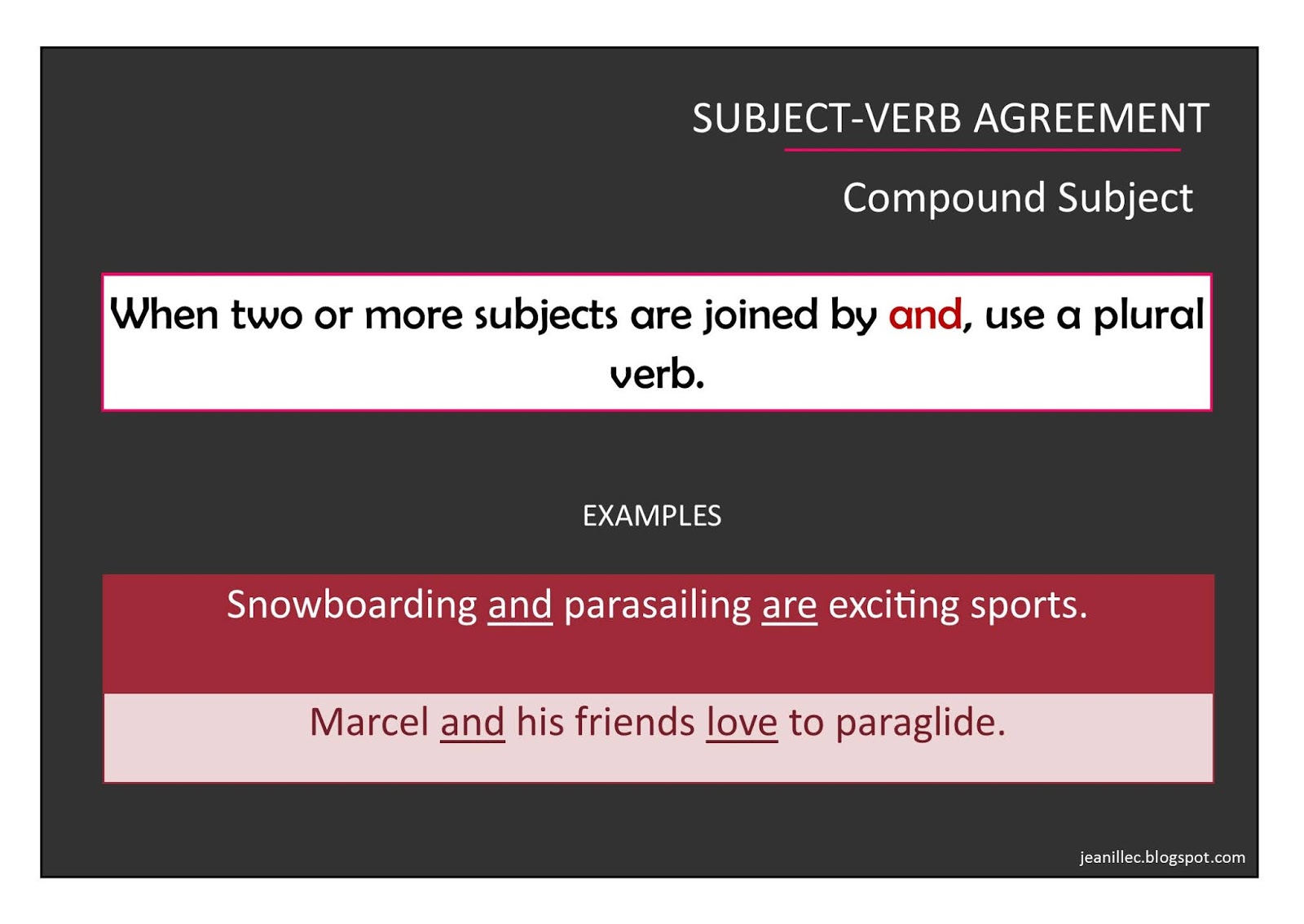
compound subject is composed of two or more subjects that use the same verb. So when this happens a plural verb must be used.


In the sentence, "Neither the coach nor the players have the trophy", the verb used is have which is plural because the nearest subject to the verb is players which is also plural.

In the sentence, "Neither the players nor the coach has the trophy", the closest subject is coach which is singular, thus the verb should also be singular.

TRY THIS!

5. Highway signs and calculators (use, uses) solar 
    panels.
6. Either Mrs. Stanley or Mr. Cruz (are, is) teaching 
    our Physics class tomorrow.
TRY THIS!

7. There (are, is) many different kinds of bowling 
    balls.
8. (Do, Does) anybody know the date tenpin bowling 
    started?
In the sentence, "Each one of the girls has new Barbie doll", the verb used is singular because the verb agrees to the pronoun "each" which is singular and not to the word "girls".
In the sentence, "Most of the fruit is ripe", the closest to the verb or the noun in the "of phrase" is "fruit" which is singular thus the verb used is singular as well, "is".

In the sentence, "Most of the apples are crisp", the closest to the verb is "apples" which is plural thus the verb "are" is used.

TRY THIS!

9. Neither of my parents (have, has) bowling ball.
10. Some of the beginners (develop, develops) their 
    own style. 


You can watch this video to learn how the rules of subject and the verb agree with subject pronouns.


Reference:
Grammar for Writing. (2009). 
New York: William H. Sadlier, Inc. 

Originally published at jeanillec.blogspot.com
in 2020.

THE ODYSSEY RETOLD

          Odysseus' Adventure began after the fall of Troy. After the 10-year bloodshed, the Greeks finally defeated the Trojans. All th...